Back Pain in Farmers: Muscle Strain or Slip Disc?



In the fields of Dhule and Khandesh, back pain is as common as the black soil. Every day, I see hard-working farmers walk into my clinic, walking with a tilt, hand on their lower back, their faces grimacing in pain. "But Doctor," she said, "Isn't this an old person's disease? My grandmother has this, not me."
Usually, they tell me the same story: "Doctor, I was lifting a sack of fertilizer (khat), and I felt a snap," or "After a long day on the tractor, my back just locked up."
Most farmers ignore this pain. They apply some balm, tie a cloth tightly around their waist, and go back to the field the next day. They assume it is just a "catch" or muscle pull.
But sometimes, that "catch" is actually a Slip Disc. And ignoring it can lead to permanent nerve damage or a lifetime of disability.
As a neurosurgeon, my goal is to keep you standing tall so you can keep working your land. Let’s understand the difference between a simple muscle strain and a dangerous disc problem.
The Anatomy of the Spine
To understand the pain, you need to understand the machinery. Your spine is a stack of bones (vertebrae). Between each bone is a cushion called a Disc. Think of this disc like a shock absorber; it has a tough outer layer and a soft, jelly-like center.
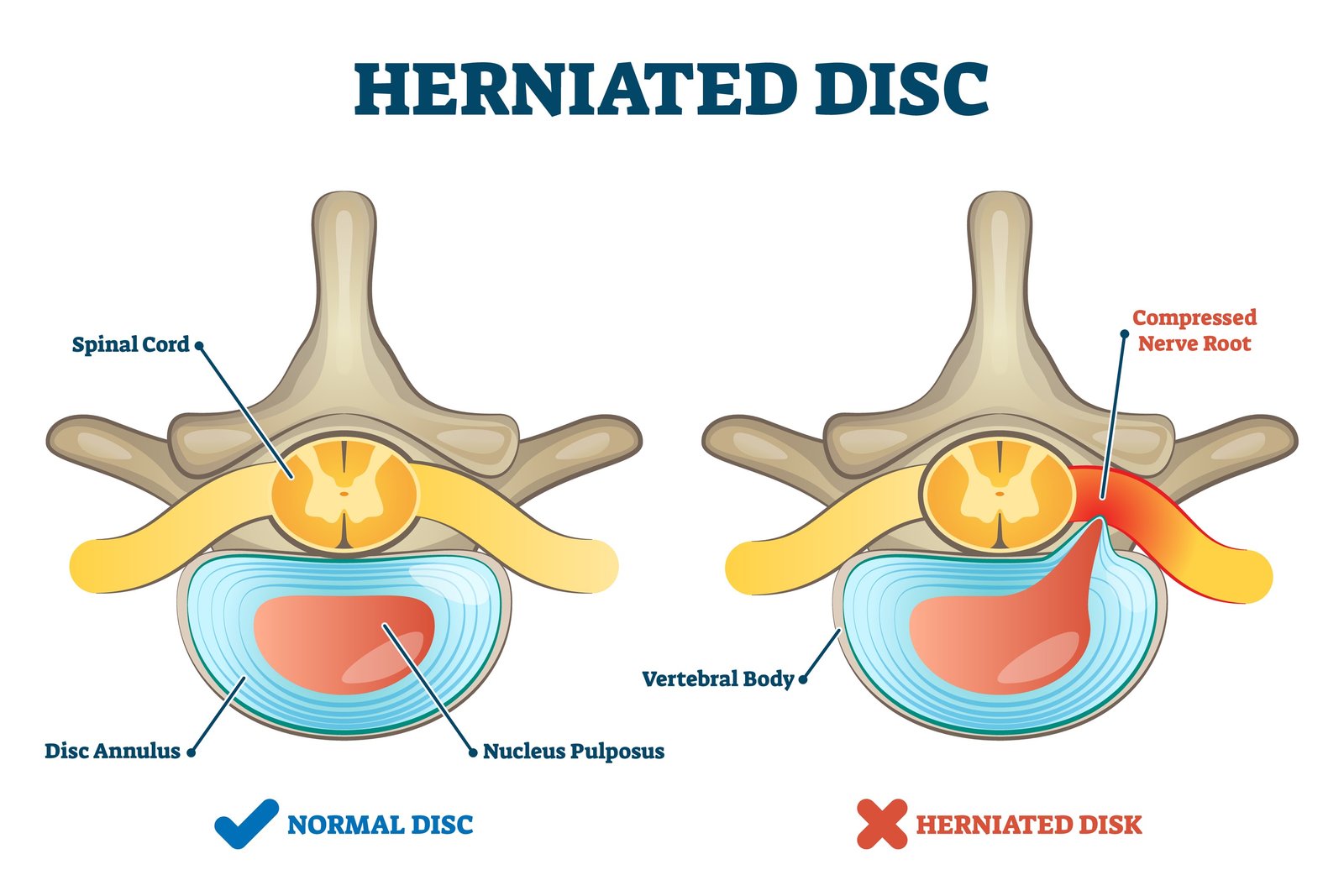
When you bend forward to lift a heavy crate of onions or cotton, you put immense pressure on these discs. If the pressure is too high, the outer layer tears, and the inner jelly leaks out. This is a Slip Disc (Herniated Disc).
If that leaking jelly touches a nerve, that is when the real trouble begins.
Scenario A: Muscle Strain (The "Good" Pain)
This is the most common type of back pain. It happens when the muscles or ligaments in your back are stretched too far or tear slightly.
How to identify it:
- The Pain stays in the back: It usually doesn't travel down your legs.
- It feels like a dull ache or stiffness: You might feel "locked up."
- It gets better with rest: After 2-3 days of rest and hot fermentation, the pain reduces significantly.
Treatment: Rest, painkillers, and avoiding heavy lifting for a week. You usually don't need a specialist for this.
Scenario B: Slip Disc & Sciatica (The "Bad" Pain)
This is where I get concerned. A Slip Disc is not a muscle problem; it is a nerve problem. The slipped disc presses on the nerves that run down your legs (the Sciatic nerve).
How to identify it:
- Current-like Pain: The pain shoots from your lower back, through your buttock, and down into your thigh, calf, or even your foot. It feels like an electric shock.
- Numbness or Tingling: Your leg or foot might feel "heavy" or like ants are crawling on it (mungi yene).
- Worse with Coughing/Sneezing: If you cough and feel a sharp pain in your back or leg, that is a classic sign of a disc issue.
- Weakness: You might find your chappal slipping off your foot, or you cannot lift your big toe.
Treatment: This requires medical attention. Ignoring this can kill the nerve, leading to permanent weakness in the foot (Foot Drop).
Why Farmers Are at High Risk
In Dhule, our farming practices are tough on the spine.
- Improper Lifting: Bending at the waist (knees straight) to pick up heavy loads acts like a lever, multiplying the weight on your lower discs by 10 times.
- Tractor Vibration: Driving a tractor for hours creates constant vibration. This shakes the spine and dehydrates the discs, making them brittle and prone to cracking.
- The "Chalta Hai" Attitude: The biggest risk factor is delaying treatment. Waiting until you cannot walk makes the treatment much more complicated.
Dr. Patil’s Advice: Prevention on the Field
You cannot stop working, I know that. But you can work smarter.
1. Lift with your Knees, Not your Back When you lift a sack, squat down. Keep your back straight and use your powerful leg muscles to stand up. Never bend your waist and twist while holding a heavy object, that is the "disc killer."
2. The Tractor Rule If your tractor seat is worn out, replace it. Use a cushion. Take a break every hour to stand up and stretch backward.
3. Recognize the Red Flags Come to the hospital immediately if:
- You lose control of your urine or motion (toilet).
- You have numbness in your private parts (saddle anesthesia).
- Your foot becomes weak (you drag it while walking).
These are signs of Cauda Equina Syndrome, a surgical emergency.
Conclusion
Your body is your most important tool, more important than your tractor or your plow. If your tractor makes a strange noise, you repair it immediately. Do the same for your back.
If you have pain that travels down your leg, do not go to a bone-setter or massage it vigorously. Come see a specialist. A simple MRI can tell us exactly what is wrong, and 95% of the time, we can fix it with medicine and physiotherapy, without surgery.
Farm safe, stay strong.